
 In this video, Tambra Divine, a Substance Use Navigator at Contra Costa Health, shared something that stood out to me: about 90% of the time, patients who come to the emergency department with substance use concerns are willing to talk with her about their situation.
That openness is not a given. Contra Costa Health has created conditions that help patients feel safe enough to talk by meeting them with empathy and practical support in a high-stakes moment. And still, choosing to engage takes personal strength.
As one Contra Costa Health team member said when the health system received a CAPH/SNI Quality Leaders Award (QLA) Top Honor last month for its cross-system behavioral health collaboration, “This award belongs to the patients whose courage guides this work.”
I believe there is another angle to what he said. The courage of patients does more than guide change; it shapes the people doing the work. It reinforces the bedrock qualities care teams already bring—humility, persistence—and sustains them as they keep striving to improve, especially on the hard days.
To hear more stories of the people and practices behind California public health care systems’ award-winning achievements, you will find additional QLA highlights and short videos below.
In the weeks and months ahead, SNI will continue supporting our member health systems by convening in-person and virtual peer- and expert-led events, learning sessions, and webinars primarily focused on:
- Maternal and child health
- Health equity
- Caring for older adults
- Data sharing between public health care systems and Medi-Cal managed care plans
We look forward to working alongside our systems to advance this work and to sharing stories of their hard-won progress for patients in future issues of SNI Forward.
Giovanna Giuliani
Executive Director
California Health Care Safety Net Institute
2025 Quality Leaders Award Winners
Top Honor: Contra Costa Health System
Transforming Transitions: Cross-System Care Collaboration for Behavioral Health
Thousands of patients relied on Contra Costa Regional Medical Center’s (CCRMC) emergency department for urgent needs related to substance use or mental health. After discharge, follow-up was often difficult to complete, leaving a gap between emergency care and ongoing behavioral health services.
In response, Contra Costa Health hired substance use navigators and placed them in the CCRMC emergency department. Navigators speak with patients and connect them to services and appointments before discharge. The health system also brought together external health systems, including John Muir and Kaiser, to strengthen warm handoffs and improve ongoing care across the county.
Key features and impact (2022-2024):
- 16% increase in mental health 30-day follow-up rates
- 19% increase in substance use 30-day follow-up rates
- More than 300 direct linkages to outpatient services
- Fewer repeat ED visits
- Catalyzed an informal, countywide peer network of substance use navigators by encouraging other systems to add navigators and connect
Care Redesign: UC San Diego Health
Telehealth Emergency Department-Transitions of Care: Transforming Care for Medicare Patients
During periods of high demand in its emergency department, UC San Diego Health focused on better supporting older adults.
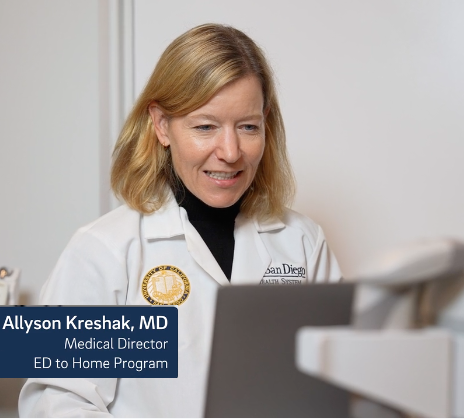
Co-designed with patients and staff, UC San Diego Health launched the Emergency Department–Transition of Care program in 2022. It provides eligible Medicare patients the option to receive hospital-level care at home, supported by virtual visits, in-home visits and diagnostics, and remote monitoring.
Patient outcomes (2021–2023):
- 16% reduction in 14-day ED revisits
- 10% increase in primary care follow-up
- Patient experience scores above benchmarks; Net Promoter Score: 90
Scale and sustained results (2022–2025):
- Improved outcomes for higher-comorbidity patients
- Measurable impact on reducing costs and increasing access
- Model scaled across University of California Health campuses
Equity: Alameda Health System
Improving Breast Cancer Screening Rates Through Care Redesign and Multidisciplinary Collaboration
From 2021 to 2024, Alameda Health System (AHS) achieved significant improvements in breast cancer screening rates. However, Black patients did not experience the same gains as the overall patient population.
In response, Alameda Health System centered the voices and lived experiences of Black patients and community members most affected by inequities in breast cancer screening through the Black Patient Care Initiative (BPCI). From 2023 to 2024, the health system’s mammography workgroup partnered with BPCI members to co-design strategies and share decision-making about how to encourage patients to get screened.
Key outputs and outcomes (2023–2025):
- Co-designed the “Getting Screened for Life” outreach campaign with members of the BPCI, community members, and staff, centering their expertise
- Produced multi-channel campaign materials, including social media content, outreach materials, and mailings
- Collaborated with community partners to distribute campaign materials widely
- Created a blueprint for co-design and shared decision-making that can be applied to other improvement work across the health system
Innovation: Zuckerberg San Francisco General Hospital/San Francisco Health Network
Sustaining Change at the Front Door: A Multidisciplinary Approach to Emergency Department Triage Design
In the wake of the pandemic, emergency department visit volume spiked nationwide. At Zuckerberg San Francisco General Hospital (ZSFG)—the city’s only Level I trauma center and safety-net hospital—the share of patients leaving its ED without being seen rose above national benchmarks, topping 10% in December 2022.
In response, ZSFG launched an ED triage redesign based on staff improvement ideas and grounded in improvement science. Interventions included refined staffing models and new roles, such as a Nursing Triage Team Lead and Patient Experience Specialist for ED Visitor Management.
Key features and impact:
- Left without being seen (LWBS) in the ED fell from 7.4% to 5.4% within three months; it remained below 2% for consecutive months in 2025
- 63% reduction in LWBS rate disparities for Black/African American patients
- Improved ED bed availability
- Improved ED staff satisfaction
- Created a blueprint for conducting improvement work throughout the hospital
Transformational Partnership: Kern Medical
Mobile Units
In Kern County, where many communities are rural and spread out, residents often face significant transportation barriers to accessing care.
In response, Kern Medical designed four fully equipped mobile medical offices that travel into communities to provide the same quality of care patients would receive in its clinics—from well-child visits to chronic disease management—as well as assistance with Medi-Cal enrollment.
Key features and impact (July 2024-June 2025):
- 2,342 patients served
- 1,676 new patients served
- 1,473 vaccinations administered
- 11% improvement across 15 quality performance measures
- Strengthened partnerships and launched new ones with 16 groups, including Fairfax School District and Black Family Wellness
Population Health: Arrowhead Regional Medical Center
Transformational Collaboration to Mitigate the Spread of Sexually Transmitted Infections in San Bernardino County
From 2020 to 2022, Arrowhead Regional Medical Center (ARMC) grew concerned about rising sexually transmitted infections in San Bernardino County: a 36% increase in syphilis, a 3% increase in congenital syphilis, and a 5% increase in HIV and chlamydia.
In response, ARMC partnered with the San Bernardino County Department of Public Health to test and treat patients earlier—while they are on site at the hospital—using navigators to connect patients to care and help reduce community spread.
Key features and impact:
- 149% increase in patient outreach
- 346% improvement in patient linkage to care
- Communicable disease rates trending down
- Saved patients’ time by receiving care on site